
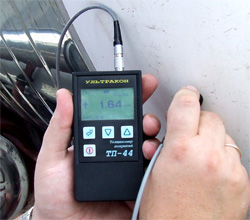
 Coating thickness gauge TP-44 provides the ability to measure:
- thickness of paint and varnish and electrically conductive non-magnetic coatings on steels;
- thickness of paint and varnish coatings on non-ferrous metals and non-magnetic alloys;
- thicknesses of bituminous and thick-layer protective coatings on various metals;
- surface roughness before painting.
The device combines two methods for measuring the thickness of coatings: eddy-current parametric and inductive magnetic.
The device is designed to measure
- the thickness of dielectric (anodic oxide, paint and varnish, mastic, plastic, Teflon, radio-absorbing, etc.) and non-ferromagnetic conductive coatings on ferromagnetic bases using induction converters ID0, ID1, ID2, F2, F4;
- thickness of dielectric coatings on electrically conductive non-ferromagnetic bases using parametric converters PD0, PD1, dielectric thick-layer coatings on electrically conductive bases using parametric converters PD2, PD3, PD4;
- point measurement of the depth of the depressions using the DSh1 sensor.
More ...
Hide
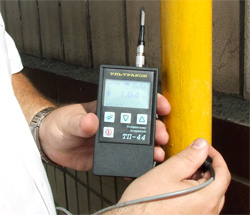 The advantages of the device include:
- wide range of measured thicknesses;
- implementation of eddy current and induction measurement methods in one device;
- large informative graphic indicator (128x64 pixels) with bright white backlighting;
- simultaneous display of the necessary information on the indicator, clarity of its presentation;
- intuitive control of the device, which increases the operator's productivity;
- minimum thickness indication;
- simultaneous display of the current and average results, as well as the number of measurements;
- indication of the beginning and end of the measurement;
- indication of the type of the connected sensor;
- memory of measurement results with page (file) organization;
- data transfer to PC via USB interface;
- battery discharge control;
- self-shutdown of the device when idle;
- small dimensions and weight;
- operating time from one set of batteries - 45 ± 10 hours, battery discharge level control;
- degree of dust and moisture protection IP54.
Technical characteristics of TP-44:
| Measured thickness range (depending on the type of sensor) | 5 μm ... 60 mm | 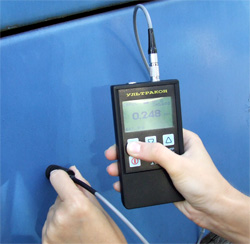 |
| Results memory locations | 2000 | |
| Number of Result Memory Pages | up to 200 | |
| Overall dimensions, mm | 122x65x23 | |
| Working temperature range, ° С | from -5 to + 40 | |
| Food | 2 AA batteries or accumulators | |
| Weight of electronic unit with battery, no more, kg | 0.2 |
Main technical characteristics of sensors:
| Coatings on steels (dielectric and electrically conductive coatings on ferromagnetic metals and alloys) | |||
Sensor type | Coating thickness | Measurement error | Sensor dimensions, mm |
| F2 sensor | 0-5000 μm | ± (3% + 2 μm) | d17x40 |
| sensor ID0 | 0-300 μm | ± (3% + 1 μm) | d5x40 |
| sensor ID1 | 0-500 μm | ± (3% + 1 μm) | d7x14 |
| sensor ID2 | 0-2000 μm | ± (3% + 2 μm) | d9x35 |
| Coatings on non-magnetic metals (dielectric coatings on non-ferromagnetic metals and alloys) | |||
| PD0 sensor | 0-500 μm | ± (3% + 2 μm) | d12x35 |
| PD1 sensor | 0-2000 μm | ± (3% + 2 μm) | d12x35 |
| Thick coatings on metals (dielectric coatings on metals) | |||
| F4 sensor | 0-15 mm | ± (3% + 0.02 μm) | d25x45 |
| PD2 sensor | 0.5-12 mm | ± (3% + 0.02 μm) | d15x50 |
| PD3 sensor | 1-30 mm | ± (3% + 0.03 μm) | d40x50 |
| PD4 sensor | 1-60 mm | ± (3% + 0.05 μm) | d70x60 |
| Roughness measurement, Rz (after sandblasting before painting) | |||
| DSh1 sensor | 2-360 μm | ± (3% + 2 μm) | d12x45 |
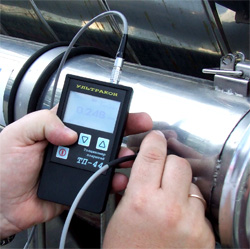
Examination of metals and alloys
| Service (for 1 sample) | Deadlines | Price without VAT* |
| X-ray fluorescence analysis | ||
X-ray fluorescence spectrometry (XRF)  |
up to 6 days | 77 USD |
| X-ray fluorescence spectrometry (XRF, without issuing a protocol) | up to 3 days | 31 USD |
| Sample preparation for XRF mechanical | up to 5 days | 79 USD |
| Sample preparation for XRF with annealing (2 samples) | up to 8 days | 114 USD |
| Determination of alloy grade (carbon + alloying + grade) |
up to 7 days | 123 USD |
| Determination of alloy grade (carbon + alloying + grade, without issuing a protocol) | up to 4 days | 96 USD |
| Determination of the carbon content (DSTU 7750, AN-7529, 0.03-99.99) | up to 8 days | 96 USD |
| Atomic emission analysis | ||
| Inductively Coupled Plasma Atomic Emission Spectrometry (ICPE, >5 ppm, per sample) |
up to 21 days | 171 USD |
| Qualitative analysis of all elements (ICPE, screening, >5 ppm) | up to 21 days | 171 USD |
| Quantitative analysis of one element (ICPE, >1-10 ppb, for 1 element) | up to 21 days | 210 USD |
| Sample preparation for ICPE | up to 11 days | 72 USD |
| Analytical chemistry | ||
| Methods of analytical chemistry, simple method | up to 11 days | 243 USD |
| Methods of analytical chemistry, complex technique |
up to 21 days | 486 USD |
| X-ray diffraction | ||
| Powder X-ray diffraction (XRD) |
up to 21 days | 199 USD |
| Sample preparation of solid or liquid samples for XRD | up to 5 days | 79 USD |
| Thickness and dimension measurements | ||
| Thickness by ultrasonic method (5 points, 0.8-300 mm) | up to 11 days | 96 USD |
| Dimension by metric method (5 points) | up to 11 days | 70 USD |
| Thickness by metric method (5 points) | up to 11 days | 70 USD |
| Weight determination (10 mg-2100 g) | up to 5 days | 74 USD |
| Measurement of roughness | ||
| Surface roughness (2-300 µm) | up to 11 days | 85 USD |
| Surface roughness (Ra 0.005-16 µm, Rz 0.02-160 µm) | up to 21 days | 547 USD |
| Metal hardness measurement | ||
| Hardness on a stationary device (HB, HRC, HRB, HV) (per 1 sample) |
up to 21 days | 142 USD |
| Hardness on a portable device (ASTM A956) | up to 11 days | 103 USD |
| Microhardness (5 injections) | up to 21 days | 142 USD |
| Preparation of standard samples for hardness determination | up to 11 days | 142 USD |
| Mechanical testing of metal and alloys | ||
| Mechanical test for abrasion (first hour) | up to 11 days | 66 USD |
| Mechanical test for abrasion (every subsequent hour) | up to 2 days | 7 USD |
| Mechanical tensile testing of samples (ISO 6892-1, 2-5 samples, до 200 kН) |
up to 21 days | 219 USD |
| Mechanical testing of samples for bending (2-5 samples) | up to 21 days | 228 USD |
| Mechanical tests of samples for compression (2-5 samples) | up to 21 days | 228 USD |
| Impact test at room temperature (ISO 148-1, -5 samples) | up to 21 days | 206 USD |
| Impact testing at low temperatures (from 0 to -80 °С, 2-5 samples) | up to 21 days | 219 USD |
| Preparation of standard samples for mechanical testing | up to 21 days | 206 USD |
| Metallographic studies and SEM | ||
| Metallographic study of the structure (preparation, etching, grain, structure) |
up to 21 days | 440 USD |
| Electron micrograph + quantitative analysis of the composition (SEM EP-XRF, up to 5 points) |
up to 21 days | 234 USD |
| Sample preparation for microphotography (cutting, polishing, grinding, drying, vacuuming, deposition) | up to 21 days | 136 USD |
| Flaw detection of metals and alloys | ||
| Capillary control (first dm2) | up to 11 days | 131 USD |
| Capillary control (each subsequent dm2) | up to 11 days | 28 USD |
| Magnetic particle inspection (MPD, first dm2) | up to 21 days | 177 USD |
| Magnetic particle inspection (MPD, each subsequent dm2) | up to 21 days | 57 USD |
| Visual-optical control of joints (first line) | up to 11 days | 85 USD |
| Visual-optical control of joints (each subsequent l.m.) | up to 11 days | 33 USD |
| Visual-optical control of the base metal (first m2) | up to 11 days | 85 USD |
| Visual-optical control of the base metal (each subsequent m2) | up to 11 days | 33 USD |
| Ultrasonic flaw detection of joints (first line) | up to 21 days | 118 USD |
| Ultrasonic flaw detection of joints (each subsequent r.m.) | up to 21 days | 33 USD |
| Base metal ultrasonic testing (first m2) | up to 21 days | 118 USD |
| Ultrasonic flaw detection of the base metal (each subsequent m2) | up to 21 days | 33 USD |
| Determining the causes of damage and breakdowns | ||
| Fractographic analysis of fractures (for 1 fracture) | up to 21 days | 317 USD |
| Determining the causes of damage (for 1 question) |
up to 21 days | 317 USD |
| Coating expertise | ||
| Coating thickness determination (ISO 2808): |
||
| magnetic induction method (EN ISO 2178, ISO 3882, 10 points, 3-5000 microns) | up to 8 days | 96 USD |
| eddy current method (EN ISO 2360, ISO 3882, 10 points, 5-2000 µm) | up to 8 days | 96 USD |
| metric method (ISO 3882, 5 points, 10-2500 microns) | up to 5 days | 70 USD |
| drip method (5 points, from 2.5 µm) | up to 8 days | 131 USD |
| XRF method (ISO 3497, ISO 3882, 1 point, from 0.01 µm) | up to 6 days | 77 USD |
| gravimetric method (ISO 10111, ISO 3882, arbitration, 3 points, no limit) | up to 6 days | 258 USD |
| Sample preparation (removal of coating, up to 10 points) | up to 11 days | 46 USD |
| Study of bank bullion | ||
| Inspection of the metal surface for compliance with the sample (XRF) | up to 6 days | 77 USD |
| Checking the homogeneity of the metal (ultrasound) | up to 11 days | 96 USD |
| Checking the density of metal (hydrostatics) | up to 5 days | 81 USD |
| other services | ||
| Compliance with certificates and other documents, confirmation or refutation of brand conformity (without the cost of brand identification) | up to 21 days | 61 USD |
| Radioactivity level (gamma and beta background) |
up to 5 days | 61 USD |
The prices are approved by the director of LLC "In Consulting" 13.10.2026. Deadlines are indicated in working days
For a free consultation, you can use On-line consultation, or call us or write to the messengers.For information about the cost of services go to Tariffs or place Application for Services.



 Application template